Introduction
Machine Learning (ML) is one of the most impactful branches of Artificial Intelligence, driving innovations across industries from healthcare to digital marketing. Whether it is predicting customer behavior, analyzing SEO patterns, or powering recommendation systems, machine learning methods make sense of vast data to deliver meaningful results.
Two of the most common approaches within ML are supervised learning and unsupervised learning. Although they both aim to extract knowledge from data, the way they process and interpret information is very different. Understanding these differences is crucial for professionals in technology, marketing, SEO, link building, and other data-driven fields like mine, where automation and accuracy play a vital role in managing websites, guest posting, and digital campaigns.
Main Points of the Content
-
-
Machine Learning (ML) is a core part of Artificial Intelligence, used across industries like healthcare, finance, SEO, and digital marketing.
-
Supervised and unsupervised learning are two major approaches in ML, differing in data handling and objectives.
-
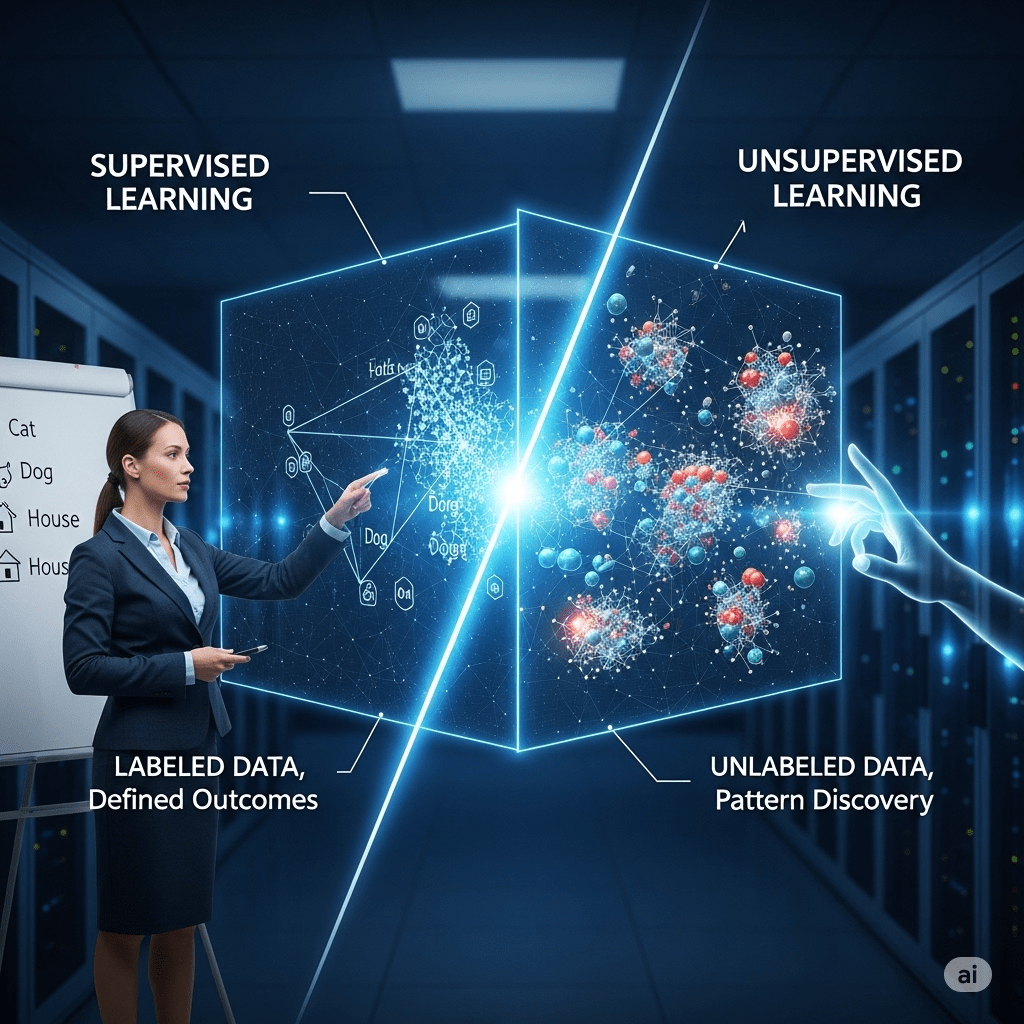
Supervised learning uses labeled data, where both input and output are known.
-
Examples of supervised learning include spam detection, stock price forecasting, image classification, and customer churn prediction.
-
In SEO, supervised learning helps predict traffic growth, keyword performance, and guest post outcomes.
-
Unsupervised learning works with unlabeled data, identifying hidden patterns and groupings without predefined outputs.
-
Examples of unsupervised learning include customer segmentation, anomaly detection, search query clustering, and website categorization.
-
In SEO, unsupervised learning helps with audience segmentation, clustering websites, and detecting backlink patterns.
-
Key differences:
-
Supervised uses labeled data, while unsupervised uses unlabeled.
-
Supervised predicts outcomes, unsupervised discovers hidden patterns.
-
Supervised is simpler, unsupervised is more complex.
-
Supervised algorithms: Linear/Logistic Regression, Decision Trees.
-
Unsupervised algorithms: K-Means, Hierarchical Clustering, PCA.
-
-
Applications of supervised learning: healthcare diagnosis, fraud detection, product recommendations, SEO traffic forecasting.
-
Applications of unsupervised learning: retail customer grouping, cybersecurity anomaly detection, keyword clustering, guest post categorization.
-
Advantages of supervised learning: accurate predictions, easy model evaluation, effective for classification/regression tasks.
-
Limitations of supervised learning: requires large labeled datasets, unsuitable when outcomes are unknown.
-
Advantages of unsupervised learning: works with abundant unlabeled data, finds hidden relationships, useful for segmentation.
-
Limitations of unsupervised learning: more complex, harder to interpret results.
-
Business benefits:
-
Supervised models help with content strategy and traffic forecasting.
-
Unsupervised models enable audience segmentation and backlink analysis.
-
Both approaches support better decision-making in SEO and marketing.
-
-
Conclusion:
-
Supervised learning is best for prediction tasks with labeled data.
-
Unsupervised learning excels at finding hidden patterns in unlabeled data.
-
Together, they complement each other and provide powerful solutions for industries, especially digital marketing and SEO.
-
-
What is Supervised Learning?
Supervised learning is a type of machine learning where the model is trained on a labeled dataset. This means that for every input, the correct output (or label) is already known. The system learns from this historical data and applies the knowledge to predict outcomes for new, unseen data.
For example, in SEO and link-building projects, supervised learning can be applied to predict website traffic growth based on previous keyword performance. By training the model on past data (search volume, backlinks, and content quality), it can predict how a new guest post might perform on a given website.
Examples of supervised learning tasks:
-
Predicting whether an email is spam or not
-
Forecasting stock prices based on historical data
-
Classifying images (e.g., identifying whether an image contains a cat or dog)
-
Predicting customer churn in businesses
What is Unsupervised Learning?
Unsupervised learning, on the other hand, deals with data that does not have labels. Here, the system is not given the correct output during training. Instead, it must analyze the data on its own to identify patterns, relationships, or structures.
In digital marketing and SEO, unsupervised learning is particularly useful for segmenting audiences. For instance, if you want to group your visitors into categories such as “potential buyers,” “casual readers,” or “competitors,” an unsupervised model can analyze user behavior and form clusters without needing predefined labels.
Examples of unsupervised learning tasks:
-
Customer segmentation in marketing campaigns
-
Identifying hidden patterns in user search queries
-
Detecting anomalies in network security
-
Grouping similar websites for outreach campaigns
Key Differences Between Supervised and Unsupervised Learning
| Feature | Supervised Learning | Unsupervised Learning |
|---|---|---|
| Data type | Uses labeled data | Uses unlabeled data |
| Objective | Predict outcomes based on prior knowledge | Discover hidden patterns or groupings |
| Complexity | Generally less complex | More complex since no labels are provided |
| Common algorithms | Linear Regression, Logistic Regression, Decision Trees, Neural Networks | K-Means Clustering, Hierarchical Clustering, Principal Component Analysis |
| Applications | Email classification, stock predictions, SEO traffic forecasting | Market segmentation, fraud detection, keyword clustering |
Real-World Applications of Supervised Learning
Supervised learning plays a significant role in industries where predictions are necessary:
-
Healthcare: Diagnosing diseases based on patient records.
-
Finance: Predicting loan defaults or fraud detection.
-
E-commerce: Product recommendation engines (based on past purchases).
-
SEO and Digital Marketing: Predicting content ranking potential using historical keyword and traffic data.
As someone working in SEO and link building, I use predictive models to assess which websites may provide long-term ranking benefits. By applying supervised learning principles, it becomes easier to forecast traffic gains from specific guest posting opportunities.
Real-World Applications of Unsupervised Learning
Unsupervised learning is equally important but focuses on uncovering hidden relationships:
-
Retail: Grouping customers based on purchasing habits.
-
Cybersecurity: Detecting unusual network activities or data breaches.
-
Search Engines: Clustering similar queries to improve results.
-
SEO and Link Building: Identifying natural content clusters, categorizing websites for guest posting, and detecting unusual backlink patterns.
In my work, I often rely on clustering algorithms to categorize potential websites by niche and audience type. This helps streamline outreach and ensures that link placements are more effective.
Advantages and Limitations
Advantages of Supervised Learning:
-
Provides accurate predictions when labeled data is available
-
Easy to evaluate model performance with known outcomes
-
Effective for classification and regression tasks
Limitations of Supervised Learning:
-
Requires large labeled datasets (which may be expensive to create)
-
Not suitable for tasks where outcomes are unknown
Advantages of Unsupervised Learning:
-
Can handle unlabeled data, which is more abundant
-
Useful for discovering patterns and groupings
-
Ideal for market segmentation and anomaly detection
Limitations of Unsupervised Learning:
-
More complex and harder to evaluate
-
Results may not always be interpretable without domain expertise
How Businesses and SEO Professionals Can Benefit
Machine learning is not just for large tech companies—it is equally valuable for digital marketers, SEO professionals, and link builders like myself.
-
Content Strategy: Supervised models can predict which type of content is likely to perform best.
-
Audience Segmentation: Unsupervised models can cluster users by behavior for personalized campaigns.
-
Backlink Analysis: ML models can identify high-quality backlinks vs. toxic ones.
-
Traffic Forecasting: Predict future growth from link-building campaigns using labeled historical data.
By integrating machine learning methods, businesses can not only save time but also make more data-driven decisions that improve ROI.
Conclusion
Both supervised and unsupervised learning are powerful techniques within machine learning, but they serve different purposes. Supervised learning shines when accurate predictions are needed from labeled datasets, while unsupervised learning excels in revealing hidden patterns in raw, unlabeled data.
For SEO experts, link builders, and digital marketers, understanding these two methods can open doors to smarter strategies. Predicting traffic trends, clustering audience behavior, and identifying valuable outreach opportunities become much more efficient with ML.
The key takeaway is that supervised and unsupervised learning are not competitors but complementary approaches. When combined, they provide a complete toolkit for solving diverse real-world problems across industries, including digital marketing and beyond.


